
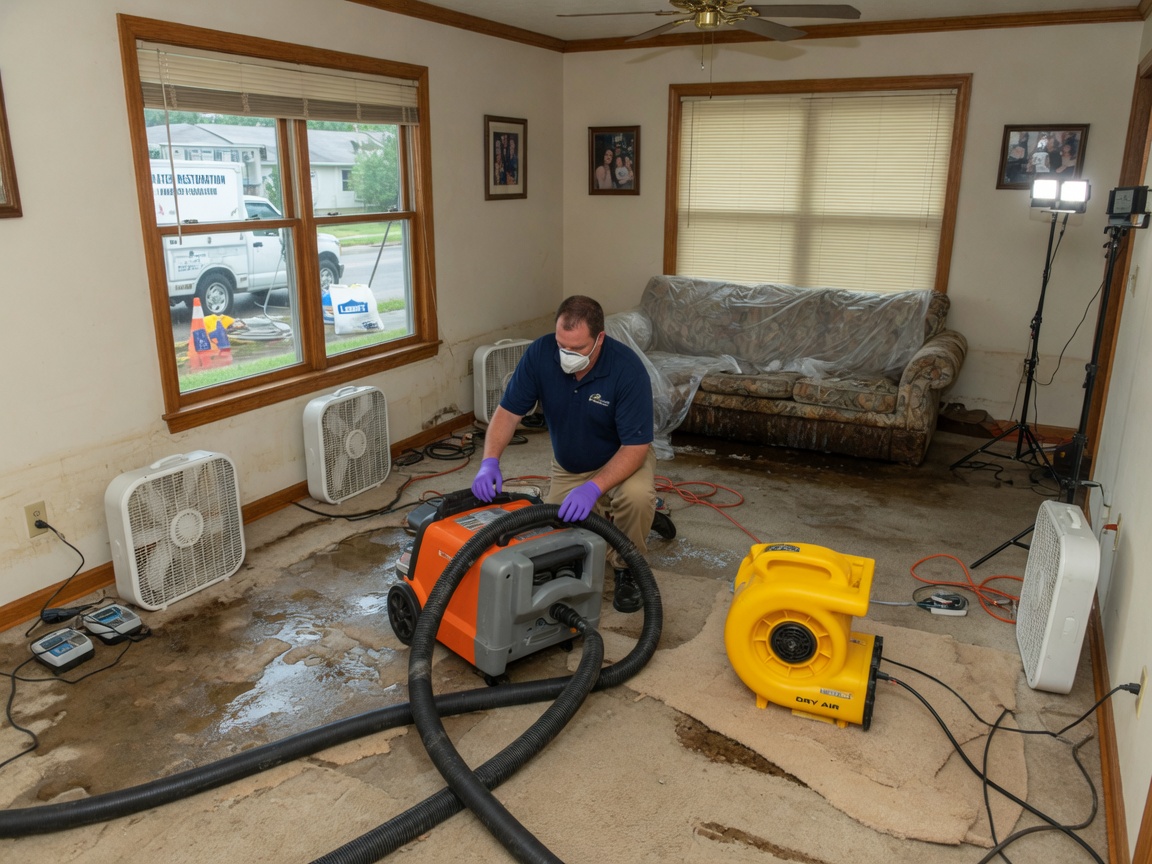
Decatur's humid subtropical climate brings heavy summer rains and occasional winter storms that quickly overwhelm older homes in Old Decatur and Albany, where many structures date to the early 1900s with plaster walls and crawl spaces. These conditions trap moisture in lath-and-plaster assemblies and under pier-and-beam floors, requiring targeted drying that accounts for the dense brick and wood framing common throughout Morgan County. Without proper airflow and dehumidification, residual dampness leads to mold within days, especially near the Tennessee River where soil moisture stays elevated year-round.
Technicians must navigate narrow alleys in historic districts and tight crawl spaces under Beltline bungalows, using moisture meters to locate hidden saturation behind baseboards and in subfloors. Point Mallard and Riverbend properties often involve slab-on-grade construction, so drying focuses on perimeter walls and HVAC returns that pull humid air from the outside. Equipment placement accounts for the mild winters that keep ground water levels high, preventing full evaporation without mechanical intervention.
Homeowners in Hartselle and Athens frequently call after sump pump failures or roof leaks during thunderstorms, and the job changes when water reaches insulation in attic spaces or behind kitchen cabinets. Extraction precedes drying to remove standing water first, then air movers and dehumidifiers run continuously while monitoring humidity levels that naturally hover above 60 percent in summer. Failure to address both visible and hidden moisture in these older builds results in recurring issues weeks later.
Technician insight
In Decatur, the thing that catches most people out with water dry out is how quickly moisture travels through the plaster and lathe in pre-1950 homes along the riverfront. The humid air keeps everything damp longer than homeowners expect, so we often have to open more walls than they think to reach hidden pockets behind baseboards in Old Decatur.
Riverbend Slab Leak
Water from a supply line leak spread under a concrete slab in a Riverbend home. Meters showed saturation extending into the kitchen subfloor and adjacent wall cavities. Extraction removed standing water, then targeted drying equipment ran for four days until readings matched surrounding dry areas.
Water Dry Out Decatur Al Services We Offer
✓Crawl Space Water Dry Out
Removes standing water and dries soil and joists under older Decatur homes to prevent structural rot in pier-and-beam foundations common in Old Decatur.
✓Slab Leak Drying
Extracts water from under concrete slabs and dries perimeter walls in Riverbend and Point Mallard properties where leaks travel along plumbing runs.
✓Attic Moisture Removal
Sets up drying equipment in attic spaces after roof leaks, targeting insulation and rafters in Albany and Beltline homes exposed to summer storms.
✓Wall Cavity Dehumidification
Uses injected air and dehumidifiers to pull moisture from plaster and drywall cavities in historic structures around the Princess Theatre district.
✓Flooring and Subfloor Drying
Lifts and dries hardwood and carpet padding while addressing moisture trapped in subfloors of Morgan County homes built before central air conditioning.
Water Dry Out Decatur Al Cost in Decatur, AL
| Service | Typical Range | What Affects It |
|---|---|---|
| Initial Assessment | $100–$200 | Covers meter readings in homes across Old Decatur or Albany |
| Single Room Dry Out | $450–$850 | Includes equipment for 3–5 days in slab or crawl space homes |
| Whole House Drying | $1,200–$2,400 | Multiple zones in larger properties near Point Mallard Park |
| Crawl Space Extraction | $600–$1,100 | Higher when soil saturation requires extended runtime |
Ranges are typical for Decatur, AL and confirmed with an exact written quote before any work starts.
How it works
- 1
On-Site Assessment
Technicians arrive from the 4th Ave NE base and use meters to map water migration through the specific construction type found in each Decatur neighborhood.
- 2
Standing Water Extraction
Pumps and vacuums remove visible water before humidity levels rise further in the humid subtropical air.
- 3
Equipment Setup
Air movers and commercial dehumidifiers are positioned to create directed airflow through affected walls, floors, and crawl spaces.
- 4
Daily Monitoring
Readings are taken every 24 hours until moisture content returns to normal levels for the local climate.
- 5
Final Verification
Final meter checks confirm dry conditions before equipment removal and homeowner walkthrough.
Pricing
Upfront quotes based on square footage and water depth; ranges reflect typical Decatur jobs.